How to Start Journaling: A Beginner's Guide That Feels Doable
A calm beginner's guide to journaling, with simple ways to start, what to write, and how to keep the habit realistic.
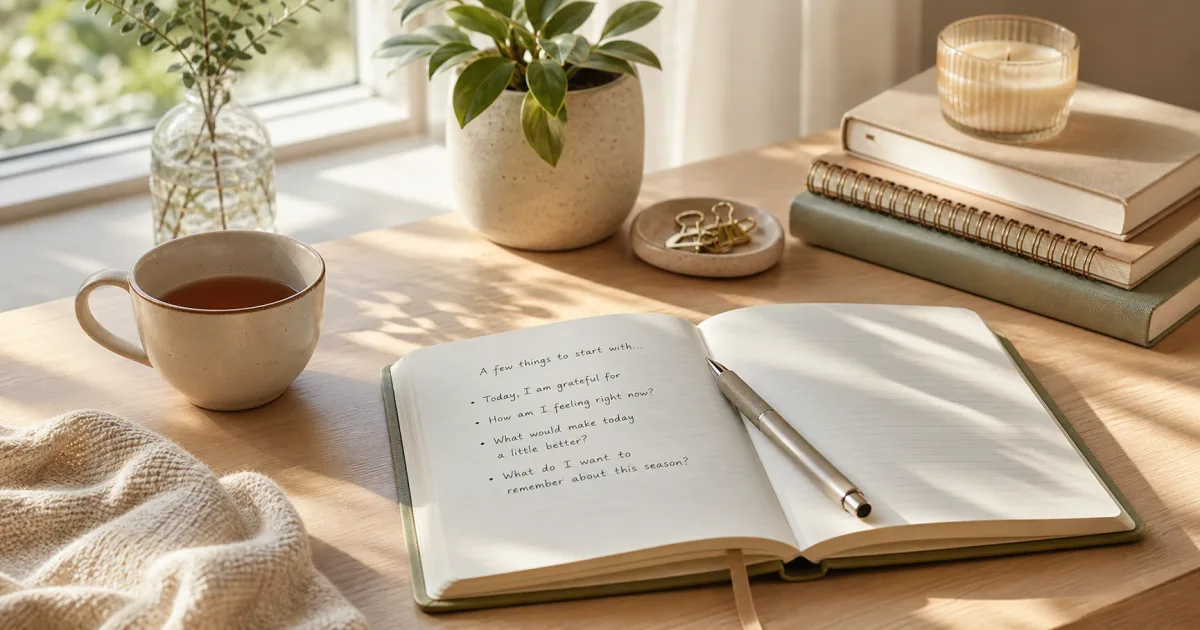
Starting a journal sounds simple until you sit in front of a blank page. Then it can feel strangely hard. You may not know what to write, how often to do it, or whether you are supposed to be reflective, grateful, organized, deep, or somehow all of those at once.
That pressure is what stops many beginners. Journaling is often presented as a beautiful ritual with perfect handwriting and unlimited time. In real life, it is more useful when it feels ordinary, flexible, and easy to return to.
This guide shows you how to start journaling without making it another performance. You do not need a complicated method. You need a gentle starting point that can hold real thoughts.
What journaling is actually for
At its core, journaling is a way to slow your thoughts down enough to see them. It gives your mind a place to put what it is carrying instead of making you hold everything at once.
For some people that means emotional processing. For others it means noticing patterns, recording daily life, making decisions, or simply checking in more honestly. A journal does not need one permanent job. It only needs to be useful to you.
This is why beginners get stuck when they try to copy someone else’s version too exactly. You are not building a journaling aesthetic. You are building a thinking space.
Choose the kind of journaling that fits you
Before you worry about discipline, choose a format that feels natural enough to repeat. Journaling gets easier when the style matches the reason you want to do it.
Free writing
Best when you need to unload thoughts, process emotions, or write without structure.
Daily check-ins
Best when you want a short habit with the same few questions each time.
Gratitude journaling
Best when you want to notice small good things more consistently. If that is your draw, a guided gratitude journal can make the habit easier to start.
Prompt-led journaling
Best when blank pages shut you down. If prompts help, the next useful step after this guide is our self-care journal prompts article.
What to write when you do not know where to begin
The hardest part of journaling is often the first few lines. When beginners say they do not know how to journal, what they usually mean is that they do not know how to start.
A blank page becomes easier when you stop asking it to hold your best thoughts. Let it hold your first honest thoughts instead. Try opening with one of these:
- Right now I feel...
- Today felt heavier than I expected because...
- The thing I keep thinking about is...
- What I need most today is...
- If I am honest, I am avoiding...
You can also describe your day very plainly. There is no rule that journaling has to begin with insight. Sometimes a simple description is what lets the real thought show up a few sentences later.
A simple 5-minute journaling routine for beginners
The fastest way to abandon journaling is to turn it into a ritual that only works on ideal days. A smaller routine is more durable.
- Set a timer for five minutes.
- Pick one question or one sentence starter.
- Write without editing for the full five minutes.
- End with one sentence about what you need next.
- Close the journal before you start judging the entry.
If your journaling is mostly about stress, mood, or mental overload, a more guided flow like the anxiety and depression journal can make this easier to repeat because it reduces decision fatigue.
12 beginner journal prompts that remove blank-page pressure
Use these when you want help starting but do not want a giant prompt dump. Pick one or two, not all of them.
- What feels most present in me right now?
- What kind of day did I actually have, not the version I told other people?
- What has been taking the most energy from me lately?
- What do I need more of this week?
- What do I need less of this week?
- What is one thing I have not fully admitted to myself yet?
- What am I grateful for today that felt easy to miss?
- What thought keeps repeating in my mind right now?
- What would make tomorrow feel a little lighter?
- What am I proud of, even if it seems small?
- What boundary or limit is asking for attention?
- What is one honest sentence I can leave myself before I stop writing?
How to stay consistent without journaling every day
Many people quit journaling because they treat missed days like failure. It is better to think of the habit as something you return to, not something you maintain perfectly.
- Keep the journal where you can see it.
- Pair it with an existing moment, like tea, bedtime, or the end of work.
- Use the same two or three prompts for a week instead of searching every time.
- Let short entries count fully.
- Restart gently after gaps instead of trying to "catch up."
Consistency comes more from reducing friction than increasing motivation. Make the practice easy to begin, and it becomes easier to revisit.
Common mistakes that make journaling harder than it needs to be
- Waiting to feel inspired before writing.
- Trying to sound profound instead of being honest.
- Assuming every entry must be long or meaningful.
- Copying someone else’s routine without checking if it fits your life.
- Turning one missed day into proof that journaling is not for you.
The fix is usually the same: make the practice smaller, truer, and easier to come back to. Good journaling is not impressive. It is usable.
Frequently asked questions
How do I start journaling for beginners?
Start smaller than you think you need to. Pick one simple format, write for five minutes, and use a prompt instead of waiting for inspiration. A beginner does not need a perfect routine, only a repeatable first step.
What should I write in a journal?
Write about what feels most present: your mood, a stressful moment, something you are trying to understand, or one thing you want to remember. Journaling works best when you write what is true, not what sounds impressive.
Do I need to journal every day?
No. Consistency helps, but daily writing is not required. Many beginners do better with a few short sessions each week because it keeps the practice realistic and easier to sustain.
What if I do not know what to say?
Use a prompt, describe your current moment, or begin with a sentence like 'Right now I feel...' or 'Today was...'. The point is to start, not to be eloquent.
Is digital journaling okay?
Yes. A digital journal can make the habit easier because it is private, portable, searchable, and easier to return to. The best format is the one you will actually keep using.
How long should a journaling session be?
Five to ten minutes is enough for most beginners. Journaling does not need to be long to be useful. A short, honest entry repeated often is usually more valuable than a long entry you avoid doing again.
Bring this practice into your day
Grateful Panda helps you save affirmations, return to them daily, and pair them with a gentler journaling rhythm when you want more structure than a screenshot or note can give you.